
News & Updates
Shark Tank vs Dragons' Den: Are They the Same Show?
Shark Tank and Dragons' Den are the same Japanese format under two names. Which came first, the real differences, and the investors who did both.
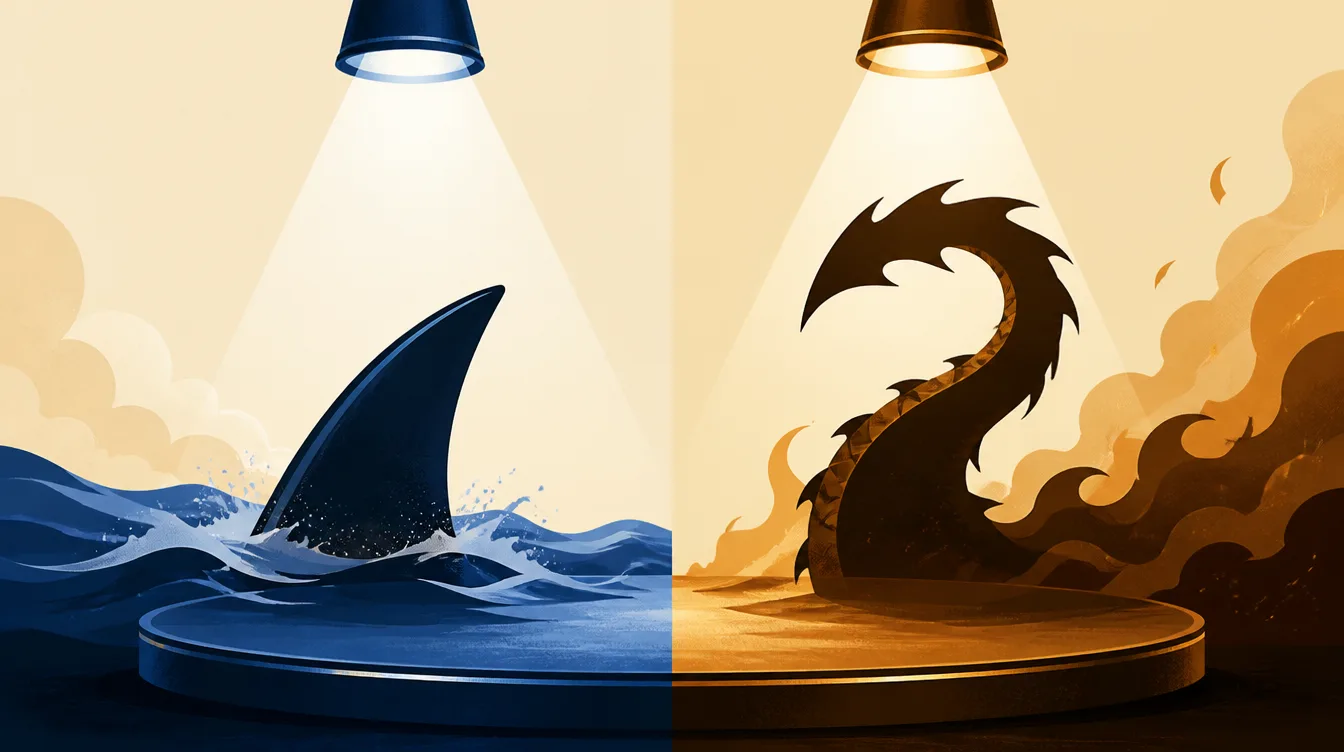
Shark Tank and Dragons' Den are two names for the same television format. Both are licensed from a Japanese show called Money Tigers, which first aired in 2001, and both send founders in front of a panel of wealthy investors to trade equity for a check. Britain's Dragons' Den brought the idea to Western television in 2005, and the United States relaunched it as Shark Tank in 2009. The differences between them are cosmetic, not structural.
If you have watched one and then flipped to the other, you already know they feel almost identical. Here is exactly how they relate, which came first, and the handful of real differences worth knowing.
Are Shark Tank and Dragons' Den the same show?
They are the same format with different branding. The format is created and owned by Nippon TV of Japan and distributed worldwide by Sony Pictures Television, and each country licenses it and gives it a local name. In Britain, Canada and Ireland the investors are called dragons and the show is Dragons' Den. In the United States and Australia they are sharks and the show is Shark Tank. Germany calls its investors lions.
The shark name did not start in America. Israel adapted the format in 2006 as HaKrishim, meaning The Sharks, three years before the United States picked up the idea and called its version Shark Tank. So when people argue about which show is the real one, the honest answer is that neither is: they are both grandchildren of a Japanese original.
Which came first, Dragons' Den or Shark Tank?
Dragons' Den came first. After the Japanese original launched in 2001, Britain's Dragons' Den became the first version outside Japan when it debuted on the BBC in 2005. Canada followed in 2006, and the United States did not launch Shark Tank until 2009. So Dragons' Den predates Shark Tank by four years, and the format itself predates both by nearly a decade.
This ordering explains a lot about the two shows. By the time Shark Tank arrived, the format had already been refined across several countries, which is part of why the American version hit the ground running and quickly became the most widely seen edition in the world.
What is the difference between Shark Tank and Dragons' Den?
The core mechanics are the same: an ask, a valuation, questions from the panel, and offers or rejections. The differences are in style and in the deals. Press coverage of the two shows consistently describes the American Shark Tank as faster and more theatrical, while the British Dragons' Den is more reserved and understated. That is a matter of tone, not rules.
The bigger practical difference is in how the investors structure deals. Shark Tank, driven largely by Kevin O'Leary, made the royalty deal a signature move, where a shark takes a payment on every unit sold rather than pure equity. Dragons' Den deals lean more heavily toward straight equity. Neither approach is exclusive to one show, but the American version popularized the royalty structure to a degree the British one never has.
There is also the matter of scale. American deals tend to run larger, in line with the size of the United States market, while the checks on Dragons' Den and other editions are often smaller. The format is the same; the dollars are not.
Do any investors appear on both versions?
Yes, and this is where the two shows overlap most directly. Kevin O'Leary and Robert Herjavec both sat on Canada's Dragons' Den, starting in 2006, three years before Shark Tank existed. Shark Tank executive producer Mark Burnett recruited both of them from the Canadian panel for the American launch in 2009, which is why two of the original sharks were already seasoned dragons.
The crossover continues in 2026. Steven Bartlett, who became the youngest-ever Dragon on Britain's Dragons' Den in 2021 at age 28, joins Shark Tank as a guest shark for Season 18. A sitting British Dragon stepping into the American tank is the clearest sign yet that these are simply two rooms in the same house.
Common questions
Why is it called Dragons' Den in some countries and Shark Tank in others? It depends on when each country adopted the format. Earlier adopters like Britain and Canada kept the Dragons' Den name, while countries that launched after the 2009 American version tended to use Shark Tank.
Who owns both shows? The same company. Both are the Nippon TV format distributed by Sony Pictures Television, licensed out to broadcasters around the world.
Which one is bigger? They are the same franchise seen through different windows, with roughly 50 official versions worldwide. The American Shark Tank is the most widely distributed single edition and has produced the largest breakout companies.
Is the money real? On both shows the on-air handshake is a non-binding agreement, and the final terms are confirmed later in due diligence, so some announced deals change or fall through after taping.
The US Tank, quantified
Compare recorded deal rates, offer amounts, participant totals and special terms, with the base stated for each figure.